
Los Angeles County homeowners may receive both an annual property tax bill and a separate supplemental tax bill. The annual bill follows the regular calendar; a supplemental bill relates to a reassessment and has its own dates. Paying one does not automatically pay the other.
Use this guide and interactive navigator to identify your document and plan your next steps. Confirm payment information on your actual bill and the Los Angeles County property-tax portal.
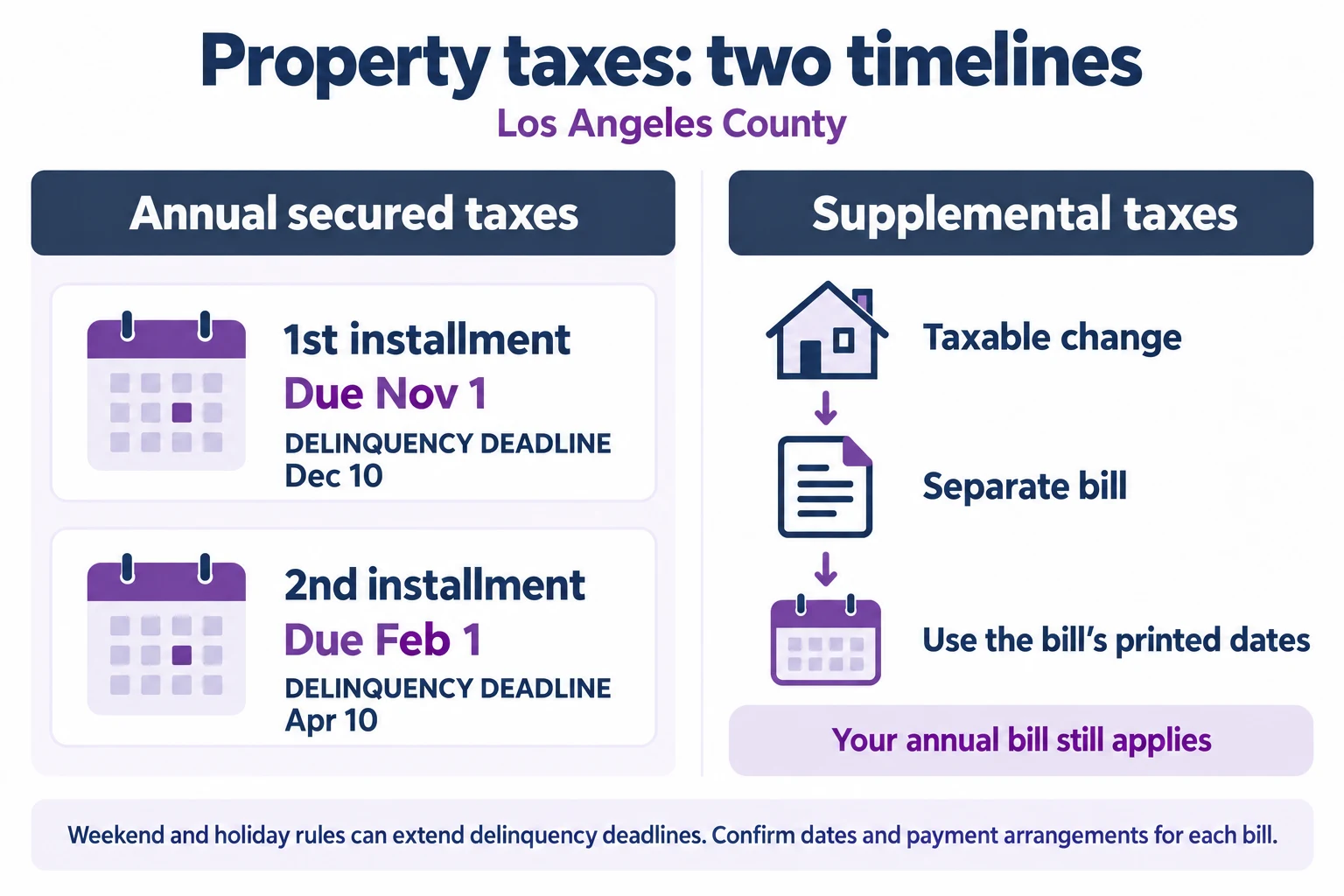
When Are Los Angeles County Property Taxes Due?
For annual secured property taxes, the due date and the date an installment becomes delinquent are different.
| Installment | Due | Standard delinquency deadline |
|---|---|---|
| First | November 1 | December 10 |
| Second | February 1 | April 10 |
If a delinquency deadline falls on a weekend or Los Angeles County holiday, it moves to the next business day. Check payment-method requirements and cutoffs in the Treasurer and Tax Collector’s current instructions.
What Is a Supplemental Property Tax Bill?
A qualifying change in ownership or completed new construction can lead the Assessor to reassess a property. A supplemental assessment generally reflects the difference between the new assessed value and the value already on the assessment roll for the applicable period. An increased assessment can produce an additional bill; a lower assessment can produce a refund.
The California Board of Equalization’s supplemental-assessment guide explains the process. Not every transfer, inheritance or improvement has the same assessment result. Ask the Assessor about exclusions or the treatment of a specific event rather than assuming a death or transfer always triggers additional tax.
A Notice Is Different From a Bill
A supplemental assessment notice explains the assessed-value change; the separate tax bill provides payment information. Ask the Assessor about valuation and the Tax Collector about billing. An assessment question does not itself resolve existing payment obligations.
Why Might There Be Two Supplemental Bills?
The event date affects the billing cycle. The state’s supplemental-assessment guide explains that January 1 through May 31 events generally result in two bills, while June 1 through December 31 events generally result in one. Multiple events can produce additional bills.
Compare the event, fiscal year and covered period before treating a second bill as a duplicate. The County’s new-property-owner guide provides more information. Bill-delivery timing varies.
Will My Mortgage Impound Account Pay the Supplemental Bill?
Do not assume so. Supplemental bills are sent to the owner and generally are not paid through lender impounds. Taxes included in a monthly mortgage payment do not establish that this separate bill is covered.
Send the bill to your lender or servicer through its approved process and confirm who will pay it. Check the printed dates while you clarify this. See the County’s secured property-tax FAQs.
How Do Property Taxes Relate to Escrow?
A closing statement may contain tax payments, prorations, credits or adjustments. A proration allocates an amount between the parties under the transaction’s arrangements; it is not, by itself, proof that a later County bill has been paid.
Ask your assigned escrow officer which tax items were paid through escrow, which were prorated and what records support those entries. Questions about an unfamiliar bill should also go to the County. Do not assume every supplemental bill received before closing belongs entirely to the seller, or that closing eliminates later billing.
Our homebuyer escrow roadmap helps organize the purchase process. Sellers can use the seller escrow checklist to prepare questions about their closing statement and estimated proceeds.
A Practical Property-Tax Checklist
- Identify the document: annual bill, supplemental bill or assessment notice.
- Match the period: check the fiscal year and reassessment event.
- Confirm payment: clarify who is handling it and check County status.
- Keep records: follow the actual bill’s instructions and retain payment confirmation.
Property and Supplemental Tax FAQs
Does a supplemental tax bill replace my annual bill?
No. It is separate from the annual secured property-tax bill. Check both and their payment status; do not assume paying one resolves the other.
Are supplemental taxes due on December 10 or April 10?
Do not use the annual delinquency schedule for a supplemental bill. Its installment deadlines depend on the bill. Follow the dates and instructions printed on it or confirm them with the Tax Collector.
Will a mortgage impound account automatically cover it?
Generally, supplemental bills are sent to the owner and are not paid through lender impounds. Obtain a specific answer from your lender or servicer about the bill you received.
Is a supplemental assessment notice a payment demand?
The assessment notice and the tax bill serve different purposes. Review valuation questions with the Assessor, and check for a separate bill with payment instructions from the Tax Collector.
Why did I receive another bill after escrow closed?
A reassessment related to a qualifying purchase or other event can produce a separate supplemental bill. Compare it with your closing statement and confirm what was actually paid. The timing alone does not establish an error.
Can Guaranty Escrow calculate or decide my property tax?
Guaranty’s team can explain the escrow statement and the tax-related entries in your file. The County handles assessment and billing. Consult the appropriate tax or legal professional for advice about your circumstances.
Plan Your Next Escrow With Jessica
For help connecting with Guaranty Escrow’s team, contact Jessica Kalkin, Business Development.
310-935-8854
Jessica@gepartnersllc.com
Already have a file? Ask your assigned escrow officer about its statement and payment records. For an assessment, bill or deadline, contact the appropriate County office. Explore our real estate escrow services.
Official Property-Tax Resources
- Los Angeles County property-tax portal and department contacts
- Los Angeles County annual property-tax guidance
- Treasurer and Tax Collector: secured property-tax FAQs
- Los Angeles County supplemental secured property taxes
- California Board of Equalization: supplemental assessments
Sources checked October 27, 2026. This guide provides general education, not a tax calculation or legal, tax or financial advice. Your actual bill, County instructions and transaction-specific facts matter.