
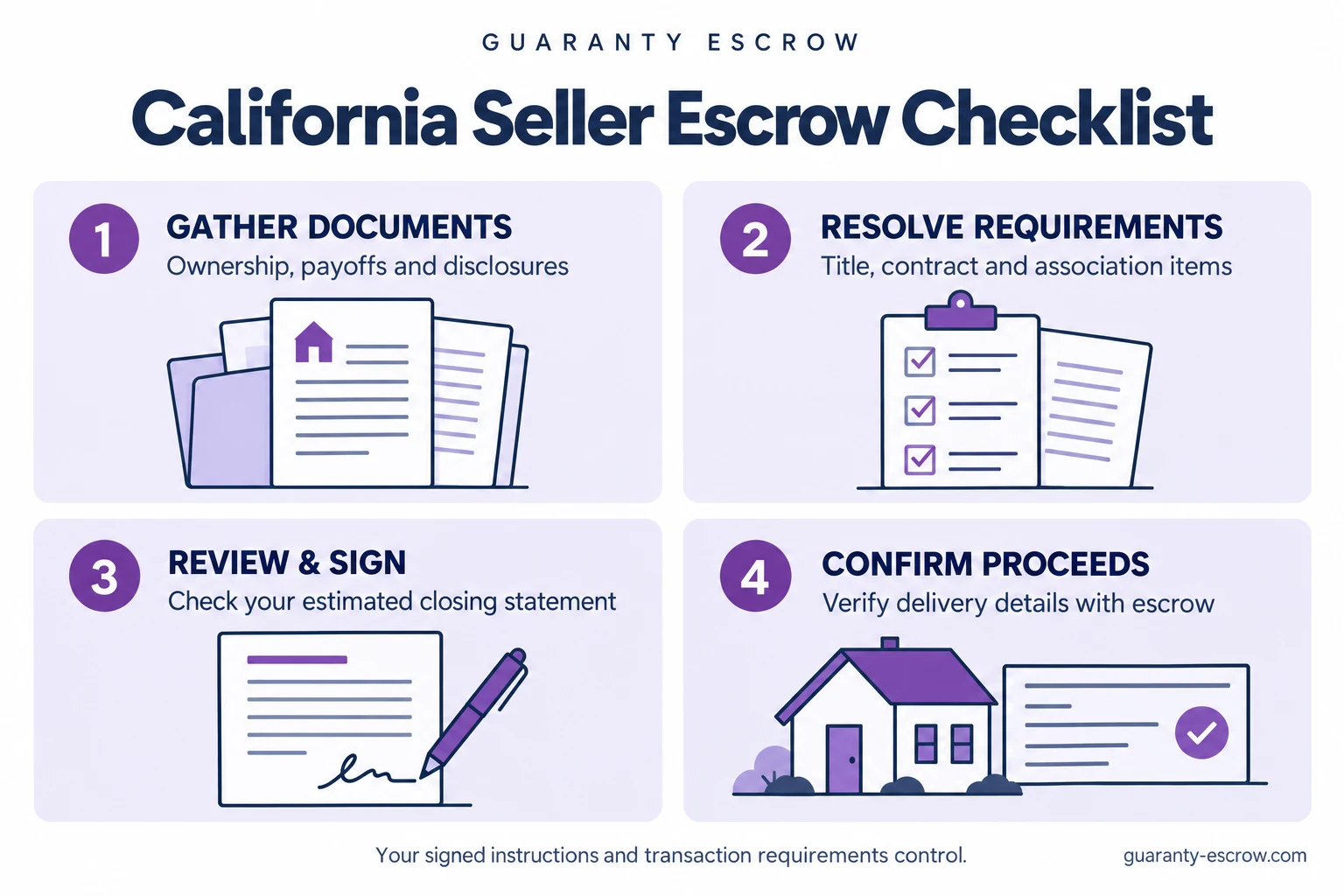
Selling a California home involves more than signing the purchase agreement. Escrow needs documents, instructions and closing conditions to come together before the sale can finish. This seller escrow checklist explains what to prepare, what to review and what to ask about your proceeds.
The short version: return your opening package, help resolve payoff and title requests, review your estimated statement, complete signing, and confirm closing and disbursement arrangements with your escrow officer. The sequence and deadlines depend on your transaction.
Seller milestones | Preparation checklist | Common questions
Interactive statement explorer
Where Does the Sale Price Go?
Open each line to see how a closing statement works. These are fictional round numbers for education, not a quote, fee schedule, tax calculation or estimate for your home.
Sale price $1,000,000
The agreed purchase price is the starting point in this simplified example. It is not the amount deposited into your account.
Loan and lien payoffs − $600,000
Amounts needed to satisfy existing loans or other payable liens can reduce proceeds. Ask about current payoff demands and any daily interest or applicable charges.
Agreed transaction charges − $50,000
This fictional combined allowance illustrates transaction expenses allocated to the seller under the agreement. Actual items and amounts vary. Ask for an itemized estimate, not a percentage assumption.
Buyer credit − $10,000
A seller credit must be supported by the applicable agreement or instructions and, when relevant, lender requirements.
Net prorations and other adjustments − $5,000
Prorations and adjustments can add to or subtract from proceeds. Their direction and amount depend on the file. Ask your tax advisor about any withholding or tax questions.
Illustrative net proceeds $335,000
Your review question: “Can you explain every difference between the sale price and my estimated net proceeds?” A final statement may differ from an earlier estimate. Payment availability is a separate question.
What to Expect During Your Sale Escrow
1. Complete the Seller Opening Package
Your escrow team will provide the instructions and forms needed for your file. These may address identification, contact details, ownership, existing loans, tax reporting and documents requiring notarization. Check the names and property details, and flag any error promptly.
If the owner is a trust, estate or entity, tell escrow at the start. The person signing may need supporting authority documents. Ask your attorney about legal authority and your tax advisor about tax forms; escrow does not make those determinations for you.
2. Help Coordinate Title and Payoff Information
Escrow and title work on the requirements for your specific sale, including payoff information for loans and other matters affecting title. Provide requested lender and association details securely, and identify issues that could require additional review.
For a South Bay condo or townhome, ask your agent and escrow officer who is requesting association documents and how outstanding association charges will be handled. Do not assume a pending sale replaces your existing payment obligations. Coordinate payment and payoff questions with the relevant lender, association and escrow officer.
3. Keep Changes and Signing Arrangements Organized
Any agreed repair credits, price changes, possession terms or other amendments should be documented through the appropriate parties. Tell escrow early if you will be traveling, signing from another location or need help scheduling the required notary arrangements.
If work or another obligation may remain after closing, discuss it with your agent and escrow officer before assuming money can simply be held back. A post-closing escrow holdback requires a separately reviewed arrangement and written release terms.
4. Review Your Estimated Closing Statement
Check the sale price, payoffs, agreed credits, charges, prorations and estimated net proceeds. Ask about any unexpected item. Your sale price is not the same as the amount you will receive after the transaction’s deductions and adjustments.
An estimated statement can change as final charges and payoff information are confirmed. Ask when your updated estimate and final statement will be available rather than assuming every file follows the same delivery schedule.
5. Complete Signing and Wait for Closing Confirmation
Return documents through the approved process and remain reachable for questions. Signing your deed or other paperwork does not by itself mean the sale is complete. Buyer funding, title, recording and other conditions may still be outstanding.
Your escrow officer will confirm the required closing milestones. Coordinate possession, keys and any move-out agreement with your agent. Keep the distinction between signing, recording, closing and disbursement clear when planning your move or another purchase.
6. Confirm Proceeds Delivery and Keep Your Records
Confirm the approved payee, delivery method, verification steps and expected disbursement timing before closing. Funds availability can depend on completion of closing conditions, final instructions, bank processing and other transaction-specific requirements. Do not make another financial commitment based only on an estimated proceeds date.
Keep your final closing statement and other important sale records for your own files. Ask your tax or legal advisor how long you should retain them. Contact escrow if you need clarification about a statement or a document after closing.
Seller Preparation Checklist
- Confirm your assigned escrow officer and trusted contact number.
- Review the opening package for accurate names, ownership and property details.
- Provide requested loan, lien, association and authority information securely.
- Discuss payment obligations and payoff questions before changing any scheduled payment.
- Return signed amendments and requested documents promptly.
- Plan identification, notarization, travel and signing arrangements.
- Review estimated net proceeds and ask about unexplained charges.
- Confirm proceeds instructions through the approved verification process.
- Wait for closing confirmation and follow the agreed possession terms.
- Keep your final statement and ask your advisors about record retention.
Protect Your Proceeds
Treat an unexpected request to change a payment destination as a reason to stop and verify. Contact your escrow officer through a previously verified number, not the contact information inside the suspicious message. Do not send account numbers or identity documents through a public contact form.
If the property is held in a trust, disclose that early and confirm the receiving-account and payee requirements before closing. Our Trust Sale Escrow service page explains how escrow coordinates trustee-led property sales.
California Seller Escrow FAQs
When will I receive my sale proceeds?
Ask your escrow officer to confirm the timing for your file and payment method. Closing conditions, recording confirmation, final instructions, banking cutoffs and processing can affect when funds are released and available. This guide does not promise same-day or next-business-day payment.
Why is the estimated net amount different from the sale price?
Payoffs, agreed credits, transaction charges, prorations and other applicable items can affect net proceeds. Review each line of the closing statement with the appropriate professional.
Does signing the deed mean escrow is closed?
No. Signing is one step. Wait for your escrow officer to confirm that the required closing conditions and applicable recording steps are complete.
Who should answer a tax-withholding or ownership question?
Your qualified tax or legal advisor should explain your obligations and ownership questions. Escrow can coordinate requested forms and transaction instructions, but does not provide individualized legal or tax advice.
Related Guaranty Escrow Resources
Questions About Your California Escrow?
Connect with Jessica Kalkin, Business Development, to discuss your transaction and reach the appropriate Guaranty Escrow team. If you already have an open file, contact your assigned escrow officer for file-specific instructions.
Call Jessica: 310-935-8854
Jessica@gepartnersllc.com
Contact Guaranty Escrow
This resource provides general education, not legal, tax, lending or investment advice. Your purchase agreement, written escrow instructions, lender requirements and transaction circumstances determine the steps for your file.
Continue Your Escrow Planning
Educational reference: California DFPI: the neutral escrow role.