
Municipal and public-agency escrow provides a defined way to hold and release funds for an agreed transaction. For housing-related programs, that can involve relocation assistance or an agency-funded ADU loan. The written agreement, program requirements and escrow instructions establish the role of each participant.
This guide helps California city staff, housing-program coordinators, property owners and their advisers organize the escrow side of a proposed arrangement. Guaranty Escrow’s holding escrow team can discuss relocation and ADU-related inquiries and the services appropriate to the specific project.
Where Escrow Can Fit Into a Housing Program
Different programs need different arrangements. Identify the purpose and parties first, then establish which escrow services are needed and can be accepted.
Relocation assistance
A city-led housing project may involve payments to residents under an approved relocation agreement. Questions to address include who funds the account, which payments are permitted, what authorizes release and how remaining funds are handled.
A voluntary relocation agreement should not be treated as interchangeable with an eviction-related or Ellis Act process. See our Tenant Relocation Escrow guide for related arrangements and the City of Los Angeles framework.
City-funded ADU loans
A public program may help a homeowner finance an accessory dwelling unit. The loan documents and program rules should clarify the intended escrow role, funding conditions, authorized recipients and payment approvals.
For a public example, Long Beach’s Backyard Builders program offers financing and assistance for ADUs. The city’s published program information explains eligibility and loan terms. Contact its administrator about applications; contact Guaranty about the escrow arrangement. Explore our ADU Escrow Services.
Considering a different public-agency project? Start with a description of the proposed transaction and the conditions attached to its funds. Service acceptance and scope are established for that arrangement; this guide is not a list of every service Guaranty offers.
Why Cities and Municipalities Work With Guaranty Escrow
Guaranty Escrow brings firsthand experience with city-funded ADU loan escrows and voluntary relocation arrangements. For municipal teams, that experience means working with an escrow team familiar with the questions that arise when public-program requirements, written agreements and payment conditions come together.
Experience with municipal housing programs
Our work with ADU financing and voluntary relocation provides a practical starting point for discussing a new arrangement. We can draw on that experience to identify the escrow questions that need attention early, while recognizing that each agency’s program has its own requirements.
Familiarity with holding and release instructions
Municipal arrangements can involve funds held until specified conditions are met. Our holding escrow experience helps frame the conversation around funding, required documents, authorized approvals and the written conditions for a payment.
Clear coordination across participants
A shared understanding of who provides instructions, who approves a release and what documentation is needed helps participants prepare. Guaranty works from the agreed escrow instructions, keeping the escrow role distinct from the agency’s program and policy decisions.
A direct contact for the next steps
Agency staff can speak directly with our holding escrow team about the proposed structure, timing and documentation. This gives the project a clear point of contact for escrow questions before funding or payment arrangements are finalized.
Keep Program Decisions and Escrow Responsibilities Clear
The agency and its advisers
Establish program eligibility, awards, assistance amounts, governing requirements and the people authorized to make decisions. Legal counsel and the program administrator address rights, compliance and disputed entitlements.
The agreed escrow role
Receive and hold the specified funds or documents, follow the signed instructions, and make authorized disbursements with the required supporting records. Guaranty does not replace the public agency, lender, construction manager or legal adviser.
California’s Department of Financial Protection and Innovation explains escrow in terms of a third party holding money or other items until a specified event or condition occurs. Learn more about Guaranty’s Holding Escrow Services.
Build Your Program Preparation Checklist
Select your arrangement and current stage to see the questions worth organizing before opening or funding escrow.
Organize the relocation payment arrangement
Start with the agency-approved agreement and the requirements that apply to this property and program.
- Name the funding agency, property jurisdiction and authorized parties.
- Identify recipients, approved payment purposes and the agreed assistance amount.
- Provide the payment schedule and documents that authorize each release.
- Specify how changes, unused funds and unresolved payment requests will be handled.
Connect the ADU loan terms with the escrow instructions
Bring the agency or lender’s approved loan requirements and identify the intended role of escrow.
- Identify the program administrator, borrower and approved funding source.
- Confirm whether escrow concerns a loan closing, holding arrangement or proposed staged payments.
- List the party authorized to approve payments and any required supporting documents.
- Address unused proceeds, changed project costs and the process for amending instructions.
Define the proposed use of escrow
A different public-agency project needs its own scope discussion before an escrow arrangement is selected.
- Describe the housing-related purpose, jurisdiction and public agency involved.
- Explain what funds or documents would be deposited and who is entitled to receive them.
- Identify the event, conditions and written authority needed for release.
- Ask Guaranty which parts of the proposal it can accept and what additional parties are needed.
At the planning stage
Outline the intended transaction before establishing dates or payment promises. Ask about service acceptance, instructions, fees, funding arrangements and reporting needs.
Before funds are deposited
Confirm the executed instructions, authorized signers, payment recipients and approved funding process. Obtain instructions through Guaranty’s secure process and verify any proposed change or payment request through the team.
Before a payment is requested
Compare the request with the signed instructions. Gather the specified authorization and supporting documents, and resolve any missing approval or change through the agreed process.
This planning tool does not determine eligibility, approve an escrow or authorize a payment. Your selections stay on this page and are not submitted or stored by this tool.
JavaScript is unavailable. All checklists are shown above; use the arrangement and stage relevant to you.
How a Municipal Escrow Arrangement Takes Shape
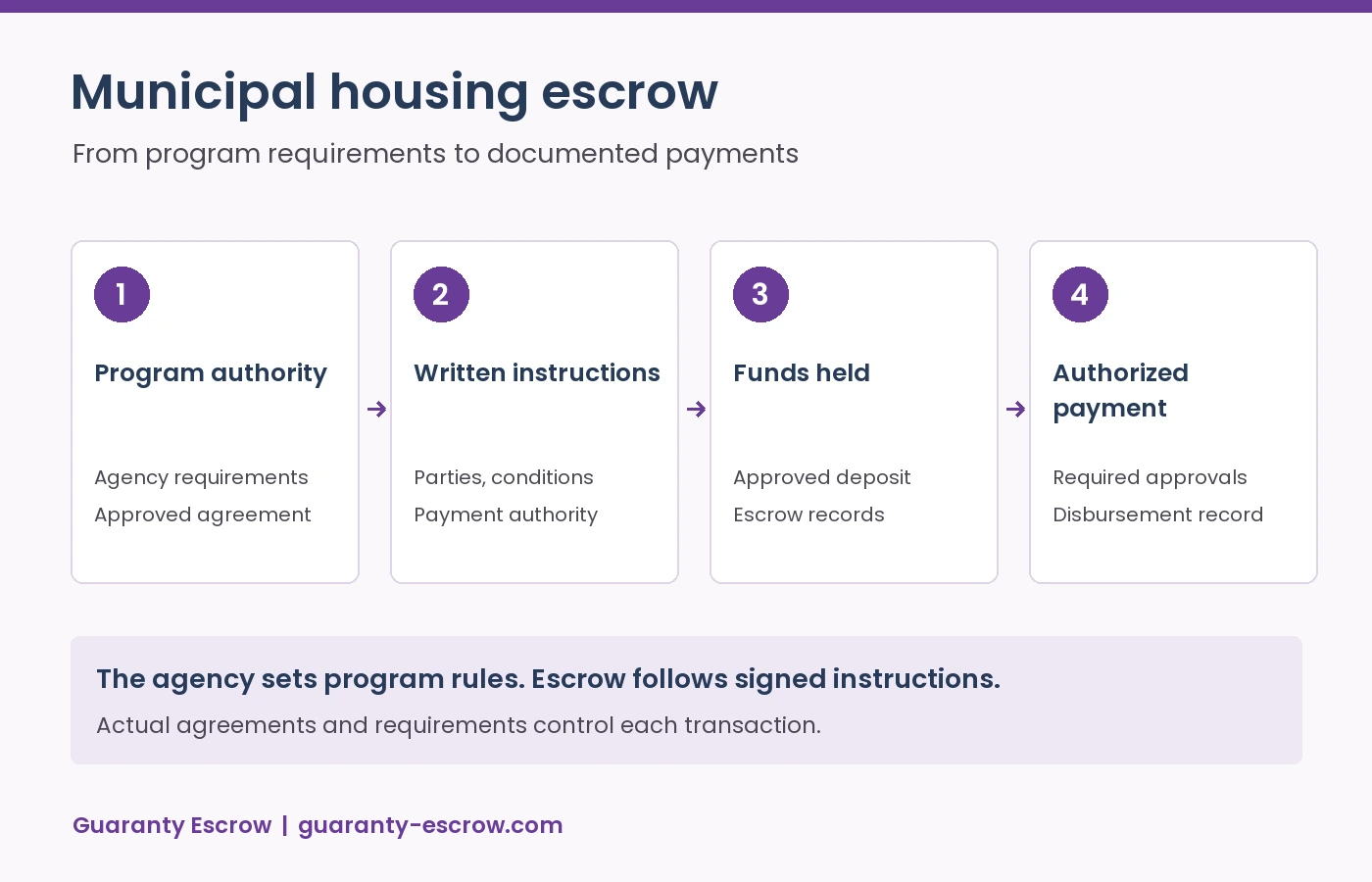
- Define the transaction. Identify the agency, jurisdiction, participants, agreement and intended use of funds. Confirm that the proposed scope fits the escrow services available.
- Set written instructions. Establish the deposit, authorized signers, recipients, release conditions, supporting documents and process for changes or unused funds.
- Fund through the approved process. Confirm executed documents and the agreed funding requirements. Follow Guaranty’s secure instructions and verify changes directly with the team.
- Document authorized payments. Submit the approval and records required by the instructions. Retain the applicable escrow statements and payment records with the program file.
Questions to Settle Before a Program Launch
- Authority: Who may sign instructions, approve payments and authorize amendments?
- Payment conditions: What event, agreement or supporting record allows a release?
- Schedule: How do funding, approvals and payment requests fit the program timetable?
- Scope: Does the proposal involve a loan closing, holding escrow or an additional service requiring a separate provider?
- Changes and closeout: How will revised amounts, disputed requests and unused balances be addressed?
Confirm fees, required records and any program-specific reporting needs before adopting an escrow structure. Approval of public funding alone does not establish that all escrow instructions and payment conditions are complete.
Municipal and Public-Agency Escrow FAQs
What is municipal escrow?
Municipal escrow describes an escrow arrangement involving a city, public agency or a program it supports. The purpose and written instructions determine how funds are deposited, held and released. It is not a single program with identical rules in every city.
Can escrow be used for a city-funded ADU loan?
An approved ADU loan may involve a loan-closing or holding escrow arrangement, depending on the program and transaction. The agency or lender establishes eligibility and loan terms. Ask Guaranty about the specific escrow role before assuming that construction draw administration or other project services are included.
Who decides when a relocation payment can be released?
The applicable requirements and signed escrow instructions establish the authorization and documents needed for payment. Escrow follows those instructions; it does not independently decide a resident’s eligibility, set assistance amounts or resolve a disagreement about entitlement.
Are voluntary relocation agreements the same as Ellis Act relocations?
No. A voluntary arrangement and an Ellis Act withdrawal are different situations. The jurisdiction, program rules and agreement matter. Use the Tenant Relocation Escrow guide for an overview, and have the agency or its legal counsel identify the requirements for the actual project.
Does Guaranty approve applications or award public funding?
No. Questions about program eligibility, lottery selection, loan awards or public funding belong with the agency or designated administrator. Guaranty’s role concerns the escrow services it agrees to provide under the transaction’s instructions.
What should a public agency bring to an initial escrow discussion?
Bring a general program description, jurisdiction, proposed parties, funding source, agreement status, expected payment schedule and authorization requirements. The team can then discuss service fit, documentation, fees and next steps. Use the appropriate secure process for confidential records.
Talk With Guaranty’s Holding Escrow Team
Planning a relocation or agency-funded ADU arrangement? Contact Matthew Bond, Holding Escrow Specialist/Escrow Officer, to discuss the escrow services and next steps for your project.
Related Guaranty Escrow Resources
- Holding Escrow Services: the broader role of holding funds under agreed instructions.
- Tenant Relocation Escrow: residential, commercial and City of Los Angeles relocation considerations.
- ADU Escrow Services: escrow considerations for accessory dwelling unit projects.
Official Program and Escrow Information
- City of Long Beach: Backyard Builders ADU program.
- California DFPI: About the Escrow Law.
- Los Angeles Housing Department: RAC 960 relocation assistance escrow accounts. This is City of Los Angeles guidance and does not establish another city’s requirements.
Prepared November 4, 2026. Program rules and availability can change. Confirm current requirements with the issuing agency. This guide provides general education and does not establish program eligibility, authorize a disbursement or provide legal, tax or lending advice.