
When California real estate is held in a trust, preparing for the sale includes more than agreeing on a price. Escrow and title need to coordinate the requested authority documents, closing instructions and proceeds arrangements for that transaction.
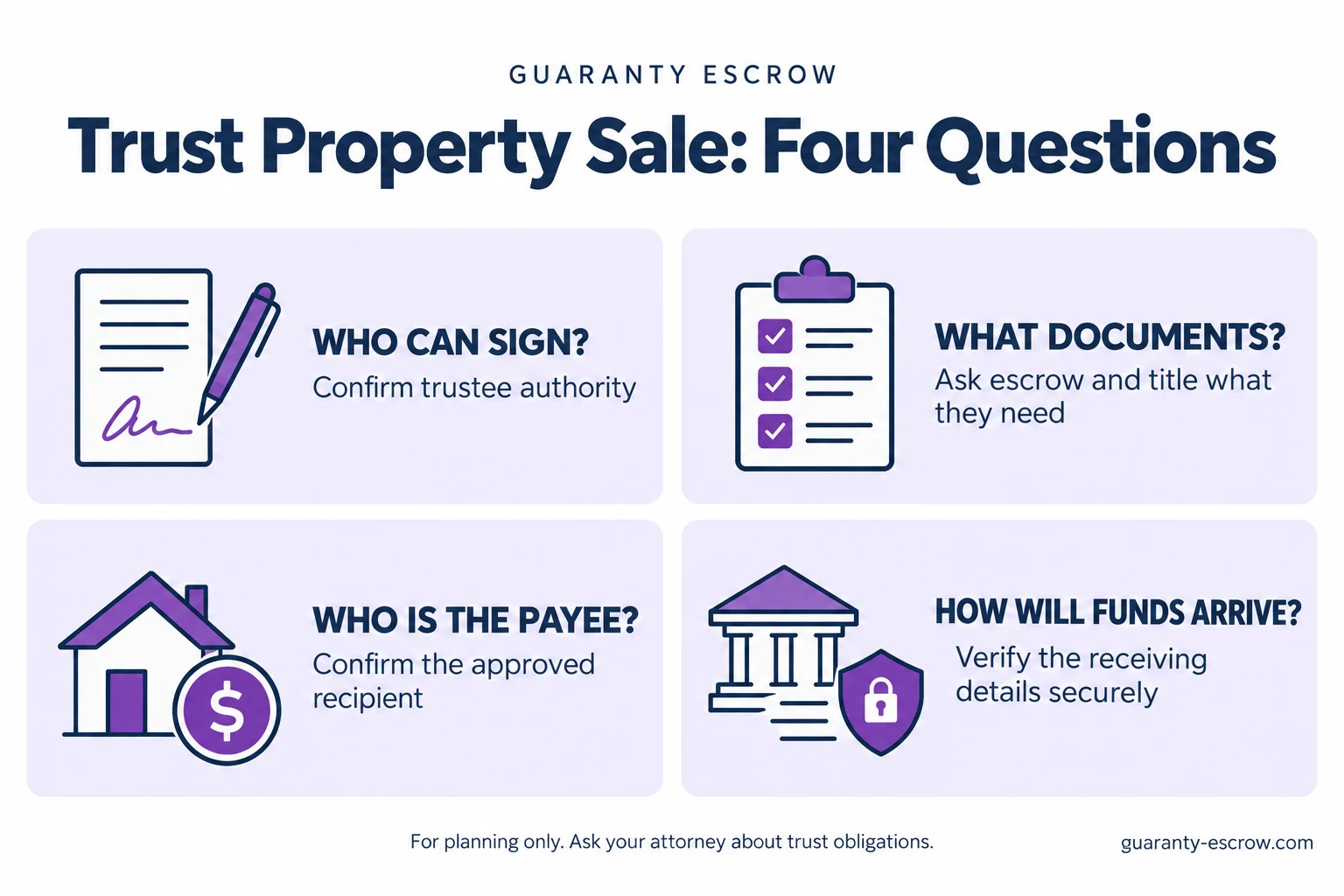
Start early: tell your escrow officer the property is trust-owned and ask what must be confirmed about the authorized signer, exact payee and receiving account. Do not assume sale proceeds can be sent to a trustee’s personal account or divided among beneficiaries at closing.
This guide addresses the preparation questions to raise with your professionals. It does not interpret a trust or determine who is entitled to its assets. For service information, visit Guaranty Escrow’s Trust Sale Escrow page.
Interactive conversation checklist
Prepare for Your Trust-Sale Conversation
Check a topic when you have discussed it with the appropriate professional. No names, account numbers or documents are needed. Your selections stay on this page and are not submitted or saved.
0 of 5 topics discussed
This is not an approval test. Completing the checklist does not establish trustee authority, approve a receiving account or confirm readiness to close. Your professional team must resolve the requirements for your transaction.
The checkboxes work without JavaScript; the progress counter requires JavaScript.
Separate the Property Closing from Trust Administration
Escrow coordinates the property transaction under approved written instructions and closing requirements. Decisions about trustee powers, beneficiary rights, distributions and tax treatment belong with the appropriate legal or tax advisors.
The name used in everyday conversation may not be the exact name needed on title, closing documents or payment instructions. Give escrow and title the requested information so discrepancies can be identified before the scheduled closing.
Five Questions to Resolve Before Closing
1. Who Is Authorized to Sign?
Identify the currently acting trustee or trustees and disclose any successor-trustee situation early. Ask escrow and title which authority documents and signatures they require. If there is uncertainty or disagreement about authority, consult the trust’s attorney rather than asking escrow to interpret the trust.
2. Which Documents Will Escrow and Title Request?
Requested items may include identification, a certification of trust, relevant trust information, amendments or records supporting a change of trustee. The required package varies. Ask for the file-specific checklist and the approved secure way to provide it; do not send an entire trust or sensitive records through a public inquiry form.
3. What Exact Payee and Account Details Are Acceptable?
Before planning the transfer of proceeds, ask escrow, title and your bank to confirm the payee and receiving-account requirements. Have the authorized trustee coordinate any needed account setup with the bank. Resolve name differences or account limitations before they become a closing issue.
Do not substitute a personal account, beneficiary account or different payee without the required review and written approvals. This guide does not establish a universal payout rule or authorize a particular account.
4. What Will Affect Net Proceeds and Timing?
Review the estimated closing statement for payoffs, charges, credits, prorations and other applicable items. Ask your tax advisor about any tax questions and provide the forms requested for the transaction. The contract price is not necessarily the amount available after closing.
Confirm when the approved proceeds instructions must be received and how release and bank availability will be communicated. Signing, recording, completion of escrow and funds availability are different milestones. Avoid promising a distribution date to beneficiaries based on an unconfirmed closing estimate.
5. Who Handles Any Later Beneficiary Distribution?
Ask the trust’s attorney and tax advisor about the trustee’s responsibilities after the property sale. A completed real estate escrow does not, by itself, resolve the trust’s remaining administration. Do not assume the property escrow will divide proceeds among beneficiaries or settle a disagreement about their shares.
Trust-Sale Preparation Checklist
- Tell your agent and escrow officer that title is held in a trust.
- Identify the acting trustee or trustees and any change in authority.
- Request the transaction-specific document and signature checklist.
- Use the approved secure process for trust records and identification.
- Confirm exact payee and receiving-account requirements with the relevant professionals.
- Address bank-account setup or naming differences early.
- Review estimated proceeds and applicable tax-form questions.
- Verify instructions through a trusted contact before funds move.
- Confirm closing and disbursement status before planning further distributions.
- Keep closing records and obtain separate advice about trust administration.
Guard Against Payment-Instruction Fraud
Trust sales can involve several participants, making clear communication especially important. Verify who is authorized to give instructions and use the approved secure process. If an email introduces new payment details or unusual urgency, stop and call your escrow officer using an independently verified number. Do not rely on a signature block or familiar-looking email address as proof of authenticity.
Trust Property Sale Proceeds FAQs
Can proceeds go to a trustee’s personal account?
Do not assume that is acceptable. Ask escrow and title to confirm the transaction’s approved payee and receiving-account requirements, and have the trustee consult the bank and legal advisor as needed. No personal-account payout is authorized by this guide.
Should a trust bank account be arranged before closing?
Discuss the receiving-account requirements early with escrow, the bank and the trust’s advisors. If an account must be opened or corrected for the transaction, allow time for the bank’s process and required documentation.
Will escrow distribute the proceeds directly to beneficiaries?
Do not assume direct distributions are part of the property closing. Any proposed arrangement requires review of the applicable authority, instructions and closing requirements. Questions about beneficiary entitlements belong with the trust’s attorney.
Can escrow explain or resolve conflicting trust instructions?
Escrow can identify requested transaction documents and coordinate closing instructions. It does not provide a legal interpretation of the trust, decide beneficiary rights or resolve trustee disputes. Obtain advice from the appropriate qualified professional.
Is a trust sale the same as a probate sale?
No. They involve different authority and administration questions. Ask qualified legal counsel which process applies to the property. Guaranty provides separate information about probate escrow.
Related Guaranty Escrow Resources
Questions About Your California Escrow?
Connect with Jessica Kalkin, Business Development, to discuss your transaction and reach the appropriate Guaranty Escrow team. If you already have an open file, contact your assigned escrow officer for file-specific instructions.
Call Jessica: 310-935-8854
Jessica@gepartnersllc.com
Contact Guaranty Escrow
This resource provides general education, not legal, tax, lending or investment advice. Your purchase agreement, written escrow instructions, lender requirements and transaction circumstances determine the steps for your file.
Continue Your Escrow Planning
Educational reference: California DFPI: the neutral escrow role.